
Hellenic DNA has always stood close to Greek culture and to Greek artists and creators who carry their work beyond Greece, supporting and highlighting their presence across the United States and around the world.
Hellenic DNA – Panos Satzoglou.
From New York and the broader Greek American community to artists building international careers, Hellenic DNA continues to share the stories of Greeks whose creativity, talent, and vision create meaningful bridges between Greece and the world.
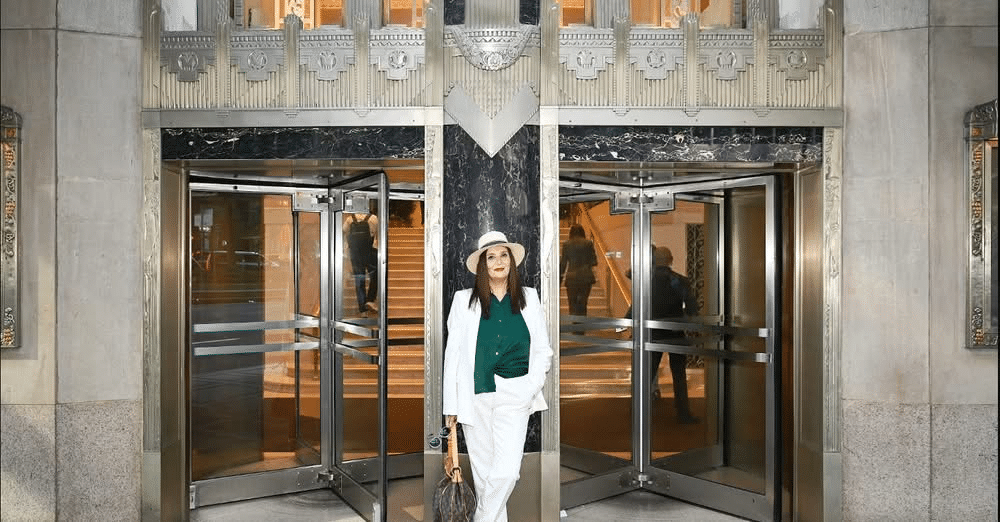
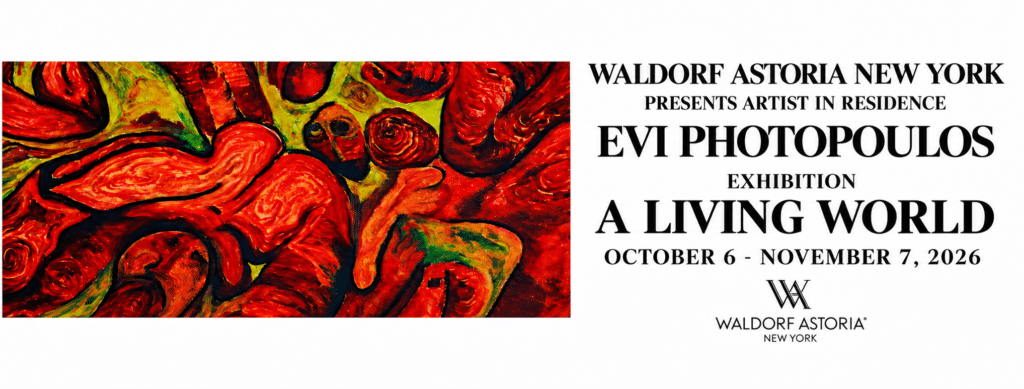
One of those creators is Evi Photopoulos, a Greek visual artist, screenwriter, director, author, and poet, who is currently in New York as an Artist in Residence at Waldorf Astoria New York, presenting her multidisciplinary project “A Living World.”
Bringing together live painting, cinema, music, storytelling, and performance, “A Living World” invites audiences to experience not only the finished work of art, but the creative process itself as it unfolds.
In an interview with Hellenic DNA, Evi Photopoulos speaks about this important chapter in her artistic journey, the experience of creating inside one of New York’s most iconic landmarks, her connection to the Greek American community, and the people who helped make the project possible — including internationally acclaimed Greek chef Maria Loi, whose support and belief in her work played a pivotal role in bringing “A Living World” to the Waldorf Astoria.
She also reflects on her Greek roots, the influence of mythology and Byzantine iconography on her work, her ambitions for the “Warriors of Hallan” trilogy, and the creative journey that continues to connect New York with her base in Chania, Crete.
Ms. Photopoulos, you are currently in New York as an Artist in Residence at the historic Waldorf Astoria. How does it feel to transform such an iconic setting into a “living art studio,” and what response are you sensing from American audiences?
I feel deeply moved, but also a profound sense of responsibility. Waldorf Astoria New York is a place with an extraordinary history, where people, cultures, and different eras have come together for generations. Through “A Living World,” I want to add a living artistic experience to that history — a space where art is not only presented as a finished work, but is created, evolves, and encounters the public every day.
Being the first Greek female artist to be hosted at Waldorf Astoria New York as an Artist in Residence holds particular significance for me. From my earliest encounters in New York, I have sensed genuine interest and curiosity about this convergence of different art forms.
“A Living World” opened on October 6 and will continue through November 7. What interests me most now is seeing how the presence and energy of visitors will influence my own creative process. Because once a work opens itself to the public, in a way, it begins to acquire a life of its own.
Your project, “A Living World,” brings together live painting, cinema, music, and storytelling. How do visitors in New York respond when they witness the creative process itself unfolding in real time?
“A Living World” has just opened to the public, while the Performance Series begins on October 10, so I would rather allow the visitors’ true responses to emerge through the encounters themselves.
What I hope to offer is access to a side of art that usually remains unseen: the moment of choice, doubt, change, and discovery.
When someone watches a work come into being, they share in the time of its creation. A line may change direction, an image may awaken a memory, a sound may alter the entire atmosphere. Painting, cinema, my songs with music by Greek composer Kimon Pollatos, and storytelling come together within the performances to create this sense of immediacy and connection.
I would like visitors to feel not simply that they are observing a finished work, but that, for a moment, they have entered a creative process that is still alive and unfolding.
You have worked closely with the Greek American community, including as a producer on “The Life of Loi,” through LOI MEDIA for PBS. What role has the Greek Diaspora played in your artistic journey in America?
For me, the Greek Diaspora is a vital link between my roots and my artistic journey in America. Behind that connection are people who have supported me in very real ways — with trust, generosity, and genuine care.
I would particularly like to speak about Chef Maria Loi, the internationally acclaimed chef who has stood beside me since the beginning of my journey in New York and continues to do so as an invaluable source of support and, above all, as family.
Our collaboration on “The Life of Loi,” through LOI MEDIA for PBS, has been an important milestone in my journey. But our relationship extends far beyond a professional collaboration. Her advice, her help, and, most importantly, her belief in me and in my work have had profound significance in my life. I will always be deeply grateful to her.
Through relationships like these, I have come to understand the strength of the Greek Diaspora: people with shared roots supporting one another and building bridges that allow Greek culture to engage with a broader international audience.
How did your exhibition at Waldorf Astoria New York come about?
The story began with a human encounter — and with two people who believed in my work.
Without Chef Maria Loi, this opportunity would probably never have arisen in the way it did. One evening in New York, I was at Loi Estiatorio, where Luigi Romaniello, Managing Director of Waldorf Astoria New York, was also present. Chef Loi, who knew my visual work well and believed deeply in it, introduced us and showed him a selection of my work.
I still remember Luigi looking through the portfolio for quite some time, almost in silence. It was one of those moments when you have no idea whether something will come of it, yet you sense that something has begun.
Approximately two months later, after discussing my work with the Waldorf Astoria team, he invited me to explore the creation of an ambitious and unconventional artistic project — something that would go beyond a conventional exhibition and develop its own living presence within the hotel.
That was the beginning of what eventually became “A Living World.”
Chef Loi was the person who opened that door, believing in my work before there was any prospect of Waldorf Astoria. Luigi was the person who recognized what it could become within this iconic setting and had the vision to give that possibility room to develop.
I owe them both my deepest gratitude for their belief and trust.
I would also like to acknowledge Danny Harpaz and the wider Waldorf Astoria New York team. A project of this scale is never realized by one or two people alone. It requires collaboration, commitment, and countless details that the public may never see. Their support and contribution helped transform an initial idea into reality.
Now that “A Living World” has opened its doors, I hope its encounter with the public will honor the trust that all of these people placed in me and in my work.
New York is one of the world’s great artistic capitals. How are the city’s energy, contrasts, and daily life influencing your creative palette at this moment?
New York sharpens my powers of observation. Its pace, its many languages, the individual journeys of its people, and the constant movement between intensity and silence provide endless stimulation. I am particularly fascinated by the way the old and the new coexist here — sometimes within a single city block.
These impressions do not necessarily enter my work as recognizable images of New York. They may emerge as a change in the rhythm of a line, greater density within a composition or, conversely, as a need for more space and stillness.
At Waldorf Astoria, this relationship becomes even more compelling to me because I am working every day within a place where historical memory meets the contemporary life of New York.
You are a visual artist, screenwriter, director, author, and poet. When an idea comes to you, how do you decide whether it should become a painting, a screenplay, or lyrics for a song?
Usually, the idea comes before the form. It may first appear as an image, a phrase, an emotion, or even a character who suddenly begins to acquire a story of their own. I try to listen to what the idea itself needs in order to be expressed most truthfully.
Painting allows me to concentrate an entire experience into a single image. Cinema and screenwriting give me time to develop characters, relationships, and transformations. Lyrics demand a different kind of distillation — the point where language encounters music.
Sometimes the same idea moves through more than one medium because each reveals a different aspect of it. That dialogue between different forms of expression lies at the heart of “A Living World.”
Your literary and cinematic work, including the “Warriors of Hallan” trilogy, contains strong elements of mythology and transformation. How deeply are Greek mythology and Byzantine iconography rooted in these stories?
Greek mythology is a profound and enduring source of reflection for me. Myths engage with questions that remain entirely alive today: power, loss, responsibility, humanity’s relationship with nature, and the consequences of our choices. In the world of **“Warriors of Hallan,”** these questions take on their own narrative form.
My relationship with Byzantine iconography is connected more deeply to the spiritual dimension of the image, the power of symbols, and the way the visible can point toward something beyond itself.
These influences exist within me as an underlying foundation rather than something I consciously seek to reproduce. From them, I develop my own stories and my own visual world, where transformation concerns both the worlds my characters inhabit and their inner journeys.
Your screenplays have received awards at international festivals. How difficult is it for a Greek female creator to break through and distinguish herself in the highly competitive global film industry?
It is a demanding journey that requires persistence, continuous work, and, perhaps more than anything, the ability to live with uncertainty.
A work has to find the right people, the right collaborators, and the right circumstances in order to move forward. International recognition can open important conversations, but the journey from an award-winning screenplay to a completed film or television production involves many additional steps.
My Greek heritage is part of my personal voice. For me, the challenge is not to distance myself from that identity in order to become more “international,” but to preserve its authenticity while creating stories capable of touching people whose experiences may be entirely different from my own.
Every recognition gives me the strength to continue and to seek the collaborations that may ultimately allow these stories to reach the screen.
If you had to identify just one theme running through all the forms in which you express yourself — painting, cinema, and writing — what would it be?
Transformation.
I am fascinated by the way people change through what they experience: what they preserve, what they are forced to leave behind, and how they find the strength to continue.
In painting, this may emerge through organic forms, pathways, and relationships between humanity and nature. In writing and cinema, it appears through the choices characters make and the consequences of those choices.
And throughout this process, memory is always present, because no true transformation begins from nothing. It carries within it something of what came before.
Having achieved so much across different artistic fields, what is the next great dream or project you would like to realize, perhaps upon returning to your base in Chania?
At this moment, I want to devote all my energy to “A Living World” and allow this experience to unfold fully. Bringing different dimensions of my work together within one shared space is opening possibilities that I want to explore further in the future.
One of my greatest dreams is to see the world of “Warriors of Hallan” fully realized in film or television through the right collaborations. At the same time, I want to continue developing my visual work and to see it presented in museums and significant art institutions internationally.
Chania remains a place of return for me — a place where I can step away from the noise, reflect on what I have experienced, and create.
I would like everything happening now in New York — the experiences, the encounters, and the relationships being formed — not simply to mark the conclusion of a major project, but to become **the beginning of the next one.